
The clocks go back on Sunday 25 October. Suddenly it’s pitch black by five, and every house with the lights off looks like nobody’s home.
Everyone says burglaries go up in winter. But do burglaries actually increase when the clocks go back, or is it just one of those things people say? We’re locksmiths. We get called out after break-ins all over West London, so we wanted a proper answer. We went through two years of Met Police burglary statistics for London and pulled out the West London figures.
Short answer: yes. Across Kensington & Chelsea, Hammersmith & Fulham and Ealing, homes were burgled about a third more often in the dark months (October to March) than in the light ones (April to September). That’s an average of 214 home burglaries a month in winter, against 161 in summer.
Below: what the numbers show, which areas get hit hardest, and a five-minute check you can do on your front door before the evenings close in.
West London burglary statistics: what the data shows
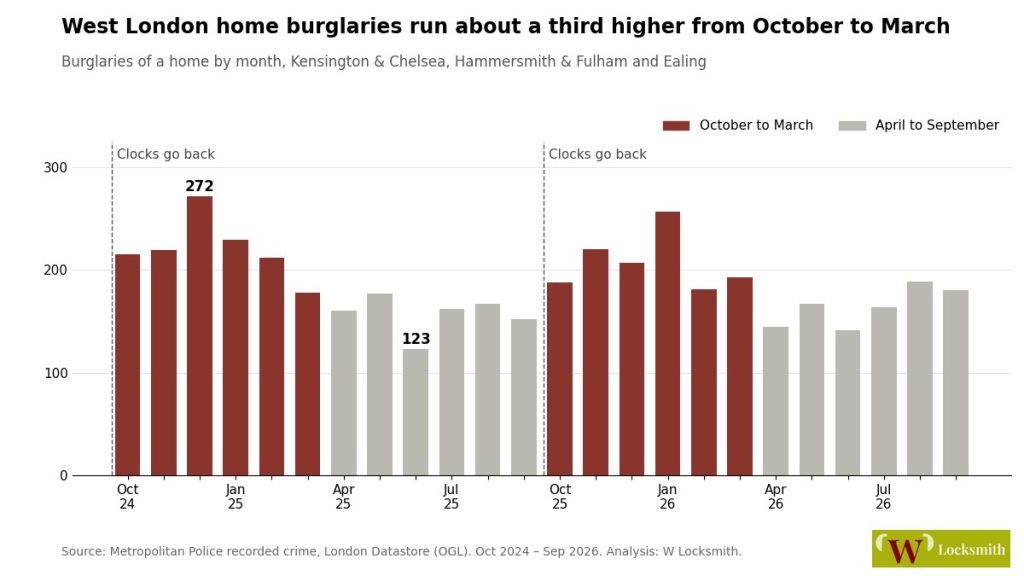
The pattern repeats in both years. Burglaries climb through October and November, peak around December and January, then fall back to their lowest point in early summer. Across the two years, December and January averaged around 240 home burglaries a month in these three boroughs, while June averaged 132.
The rise doesn’t start on the night the clocks change, but it builds quickly afterwards. In September 2025 there were 152 home burglaries across the three boroughs. By November it was 220, and by January 2026 it had reached 257, an increase of almost 70% in four months.
Borough by borough
The seasonal swing isn’t the same everywhere.
| Borough | Monthly average, Oct–Mar | Monthly average, Apr–Sep | Difference |
|---|---|---|---|
| Ealing | 107 | 63 | 71% higher in winter |
| Kensington & Chelsea | 57 | 49 | 18% higher in winter |
| Hammersmith & Fulham | 50 | 49 | Almost no difference |
Ealing shows the strongest effect by far. In June 2025 there were 37 home burglaries; in November 2025 there were 138, nearly four times as many.
Kensington & Chelsea follows the same pattern more gently, with its busiest months in December 2024 (79) and January 2026 (71).
Hammersmith & Fulham is the exception. Burglary there stays fairly steady all year, which is a useful reminder that darker evenings raise the risk but don’t explain everything. Some homes are targeted in any season.
Why burglaries go up when the clocks go back
Police data show when burglaries occur. It doesn’t tell you why. But we’re the ones fixing doors the morning after, and in winter we see the same things over and over.
A dark house looks empty. In summer you get home in daylight. From late October, no lights on at 5 pm is basically a sign on the door saying “nobody’s in”. And the dark gives cover to anyone having a go at your lock.
Doors left on the latch. We see this all the time. You pop out for ten minutes, pull the door shut behind you, and it’s not actually locked. It’s on the latch. Same when you’re home in the evening, sat upstairs with the front door just closed.
Weak cylinders. Loads of uPVC and composite front doors in London still have the standard euro cylinder they came with. Those can be snapped in seconds. It’s quick, it’s quiet, and in the dark nobody notices. It’s called lock snapping, and it’s one of the main reasons we fit anti-snap locks.
Doors that don’t lock properly. Damp autumn weather swells wooden doors and knocks uPVC doors out of line. Once you have to lift the handle hard or lean on the door to lock it, people stop bothering. Then it gets left unlocked. If that sounds like yours, here’s why a door stops closing properly.
A five-minute front door check
No tools needed. Do it this weekend, before the clocks change.
- Look at your cylinder. That’s the bit the key goes in. Look for a Kitemark with three stars (TS007 3-star) or “Sold Secure Diamond” on the face. Got one? Good, it’s anti-snap. Nothing there? It’s probably a standard cylinder.
- Check how far it sticks out. More than about 3mm past the handle and it’s easier to grip and snap.
- Lock it from both sides. The key should turn smoothly. If you have to lift the handle hard or shove the door, it’s out of alignment, or the lock is getting stiff.
- Try the handle. Door open, lift the handle. Loose or floppy? The mechanism inside could be worn.
- Count your keys. Moved in recently? Lost one? Had a lodger or tenant leave? Then you don’t really know who’s got a key.
What to do before the clocks go back
Most of this costs next to nothing.
- Put a couple of lamps on timers. Cheap, and the house looks lived-in from 4pm.
- Lock the door when you’re in. Turn the key. Don’t just shut it on the latch, especially if you’re upstairs or out in the garden.
- Swap weak cylinders. An anti-snap upgrade usually takes us under half an hour. For uPVC and composite doors, an Ultion cylinder is one of the toughest you can get. Our high security lock upgrade page covers the other options.
- Fix the door that won’t lock easily. Sort it now. A small adjustment costs a lot less than a mechanism that’s been forced all winter.
- Change the locks if you’re not sure who’s got keys. Here’s our guide to changing locks after moving house, or see front door lock replacement.
- Keep valuables and car keys away from windows and the front door.
How we analysed the data
We used the Metropolitan Police’s recorded crime figures, published monthly on the London Datastore under the Open Government Licence. We looked at the category “residential burglary of a home” for Kensington & Chelsea, Hammersmith & Fulham and Ealing, covering the 24 months from October 2024 to September 2026. We compared October to March, when the clocks are on GMT and evenings are dark, with April to September.
These are crimes recorded by the police, so they don’t include burglaries that went unreported. Figures are counted by the month the crime was recorded. For a wider look at burglary across the area, see our earlier West London burglary data analysis.
Frequently asked questions
Do burglaries increase in winter?
In West London, yes, and the rise starts once the clocks go back. Across three boroughs, home burglaries averaged about a third higher from October to March than from April to September over the last two years. The increase builds through November and usually peaks in December or January.
When do most burglaries happen?
In West London, most burglaries happen in the darker months, from November to January. The busiest month was December in the first year we looked at (2024/25) and January in the second (2025/26). June was the quietest month in both years.
What is the most common way burglars get into homes?
The police data doesn’t record the method. In our experience as locksmiths, common ways in include doors left on the latch, unlocked back doors and windows, and snapping weak euro cylinders on uPVC and composite doors.
How do I know if my lock is anti-snap?
Look for a Kitemark with three stars (TS007 3-star) or a Sold Secure Diamond marking on the face of the cylinder. If you can’t find either, a locksmith can check it for you in a few minutes.
Get your front door sorted before winter
No markings on your cylinder? Door only locks when you lean on it? Not sure who’s got a key? Give us a call on 07830 787474 or book online.
We fit anti-snap and high-security locks all over West London, 24 hours a day. Most cylinder swaps take under half an hour. No fuss, no drama.
Already had a break-in? Our burglary repair team will get your home secure again the same day.